

Concisions 101
4 - Writing concisely
Writing concisely
This is where we'll be looking at how to write clearly and concisely, two cornerstones of good copywriting.
It's no secret that concision is one of the toughest parts of copywriting, requiring ruthless editing and a strong sense of objectivity, but with these tips, you'll pick it up in no time.
Concision 101
Writing clear and concise content takes priority over everything we do. We've put together a few key areas to focus on, to make sure you're creating content that is both readable and highly informative.
Here are your top four weapons for concision:
- Kill your darlings!
- Use bullet points
- Abbreviations and jargon
- Bolding and italics
Kill your darlings!
This phrase has become a bit of a buzzword for the writers at dslx, courtesy of Ray. It's not a reference to the 2013 film, but actually a top writing tip.
Rather than talking about homicide, we're saying goodbye to all those wordy phrases or irrelevant sections you might be holding on to, despite knowing that they don't really add anything to your work.
Sometimes you have to be brutal to cut down on the waffle. Writing is as much about discipline as it is about creativity.
Have a look at our Valentine's Day LinkedIn post on why killing your darlings isn't very romantic, but necessary.
Here are some tips to keep in mind when optimizing your writing:
- Edit objectively and without sentiment.
- If something doesn't serve your purpose, let it go. Keep that purpose top of mind and remember that 'the purpose of writing isn't just for the writer.'
- Fewer words are more emphatic. Avoid qualifiers, adverbs that demonstrate moderation, like 'really', 'very', 'quite'. For instance, change 'you'll be really pleased with our new product' to 'you'll be delighted with our new product'.
- It takes practice, but try to emotionally detach yourself from your content, whether it's not taking a thorough round of edits personally or removing an irrelevant paragraph.
- Take time to plan: this avoids unnecessary sections of text and keeps your content to the point.
- Choose words carefully. Keep your language simple and your words clear.
- Edit ruthlessly: you've got to provide the reader with useful info, cover all necessary topics and include the right keywords all within a specified word count. You don't have the space (or time!) to waffle.
- Avoid redundant words, those that don't need adding as they're already implicit. For example 'the unknown stranger' or '9am in the morning' or 'extra bonus'.
- Use active voice instead of passive voice. Active voice makes writing more direct, concise, and engaging. For example, instead of writing "The ball was thrown by the boy," write "The boy threw the ball."
- Break up long sentences into shorter, more manageable ones. This makes it easier for readers to follow along and understand the content.
Take inspiration from William Strunk (author and English professor) who suggested 'Omit needless words. Why write 'not very good' when you can write 'atrocious'? Why say 'actually quite interesting' when you can say 'fascinating'?' Words to live by.
Bullet points
You might be wondering why we've given a section to bullet points: they're pretty self-explanatory, aren't they?
Yes. But we're going to explain why they're a magic resource, used to fascinate, engage, and explain.
💡 Use bullet points or numbered lists for complex ideas or instructions. This helps to break up information and make it easier to digest.
Bullet points come under the formula of what you're likely to see in any piece of copy:
- Headline
- CTA
- Body copy
- Bullet points
So why are they so great?
- Bullet points are short, bite-sized pieces of information that focus the reader's attention on key features.
- Bullet points and numbered lists draw the eye and encourage our reader to, well, if not actually read the whole piece then at least understand the main points we're making.
- Listing features is a very effective way to break up long, dense copy. Remember to put the bullets in order of importance, with the most impactful at the top of the list.
Where do we use them?
- Product details
- TL;DRs
- Reasons or effects
- Testimonials
- Statistics
What do we use bullets for?
- Conveying information quickly and clearly
- Grabbing the reader's attention
- Summarising and simplifying dense information
- Improving readability
- Highlighting important points
Here's an interesting point of view for you: bullet points are like eyebrows.
Here's why:
- Eyebrows are an important part of communicating emotions, just like bullet points are key to communicating important info.
- It just doesn't look right. Not as strong an argument but probably true. Make of that what you will.
In these examples, you'll notice that we either do a simple list of bullets, for example in this piece Liv wrote for a former client, Branch:

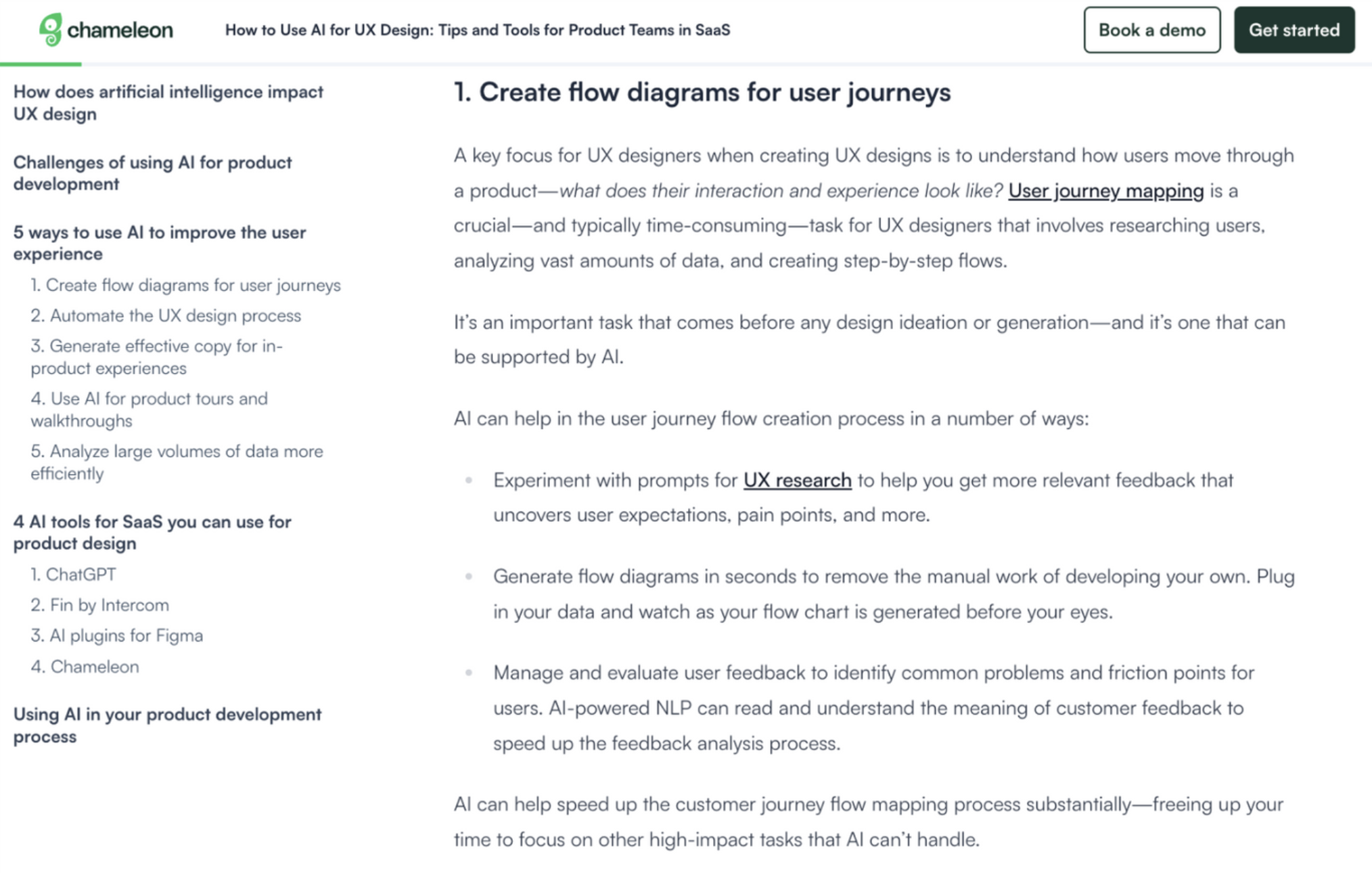
Or, we use a more detailed list where the different ways AI can help the user journey are described. Here's an example in a Chameleon piece entitled "How to Use AI for UX Design: Tips and Tools for Product Teams in SaaS" by Ella:
Abbreviations and jargon
The number one rule of using jargon, abbreviations, and acronyms is to remember who you're writing for. You want to hit the fine line between being patronizing to those who know what these terms mean, and explaining terms for newbies.
A good rule-of-thumb is to define terms at the beginning of a piece, when you first mention them. Write the term, and use brackets to signal the acronym you'll be using from now on.
Have a look at this TravelPerk example, where 'TMC' is defined in the second sentence.

You won't need to explain abbreviations everyone already knows (e.g. TV = television), but also don't define certain terms if the target audience is familiar with them. For example, if you're writing an article on developing a B2B SaaS SEO strategy, readers who find themselves on your page will likely know what these terms already mean.
Be careful with idioms. If you're writing for a US audience, avoid obscure(ish) phrases like 'barking up the wrong tree' or 'a penny for your thoughts'. You get the idea.
Bolding and italics
You'll find that at dslx we love bolding and italics to illustrate certain points, but the key to it is moderation.
💡 The bottom line is: use bold to highlight something that is important to the reader, not you, not the client.
Bolding, underlining, and italicizing are key tools in copywriting, making text more scannable and emphasizing keywords.
However, they should be used in moderation. Don't overspice 🌶 your copy, but focus on drawing attention to important points or emphatic words that contribute most to the reader's understanding of the topic.
You should be using bold in all of your content to improve readability and scannability, and to boost SEO efforts, but be careful not to over-optimize.
Here are some ground rules for the BIU features:
Bold:
- Important phrases
- Highlighting keywords
- Small headers
Italics:
- Quotes
- Names of books, blogs, newspapers, etc.
- Foreign words
- Word emphasis
Underline:
- Used less on the web, except for hyperlink