

How to research
3 - Writing correctly
Research: how to do it correctly?
Research is a key element of copywriting. In fact, having a strong research process may be the single most important factor in creating successful copy.
The way you research and compile your information contributes to the tone and authority of your writing. Even if the topic is new to you, you can use this information to come across as an expert.
Here's copywriting summed up:
A good copywriter can write effective copy for an industry they are familiar with. A great copywriter can write killer copy for a previously unknown industry.
Being able to delve deep into a topic and come out with a solid understanding of the industry is an important skill to have—and you'll be surprised at how quickly it develops over time!
Research in copywriting
Let's look at the different areas of copywriting research:
- Knowing the product
- Statistics
- Active researching
1. Knowing the product/service inside out
You might not have to write about the client's product in great depth in all your blogs but since so much of copywriting is about subtle promotion, it's essential to be familiar with your client's offering to accurately refer to it.
Ask yourself some questions:
- What does the product/service do?
- Who might need this product/service?
- What problem does it solve?
2. Statistic gathering
You don't have to scroll very far down the SERPs to work out that there are hundreds of available statistics online. I hate to break it to you, but many of these are made of thin air. A good trick is to filter your search by publishing date, at least that way you know you'll be accessing recent data; we tend to filter to within the last year, or within the last month if it's a hot topic.
Statistics can be a very valuable tool to copywriters, but only if they're rock-solid facts. They're great for backing up your argument and convincing the reader, but bear these pointers in mind when you're compiling them:
- Always link a statistic or fact to its source
- Link only to the original source (no "101 statistics about XYZ pages", please!)
- No broken links
- Where possible, avoid statistics from before 3 to 2 years ago
- Always use a statistic in context
- Double-check the information before publishing
Here's an example, from an article for Sona by Liv.
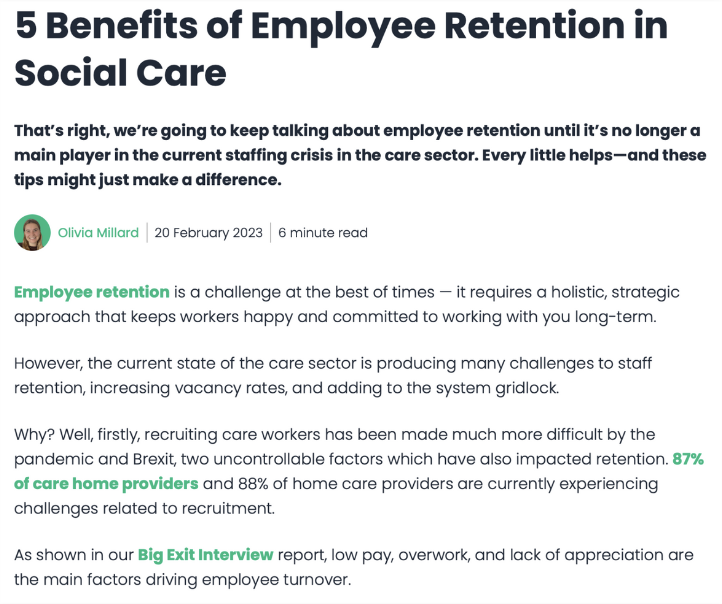
The introduction engages the reader by using and sourcing statistics that support her argument.
You'll also notice that in the third paragraph, the second stat isn't sourced - that's because it comes from the same place as the stat before it. If both statistics are in the same paragraph, you can do this.
3. Avoiding plagiarism
As you can imagine, plagiarism is a big problem if it happens. Our clients are paying us for original work, and that is what we're giving them.
- Keep track of the sources you're using: here are some research and note-taking tools worth using
- If you are using information you find on the internet, make sure it's from a reputable source (e.g. Forbes, Hubspot), and it's firmly reworded
- Credit the original author in a quote
- Run your content through a plagiarism checker if you're not sure
- Plan enough time for the writing process, so you're not rushing to collect information
The bottom line is: use your head and your common sense. If you're on the fence about something, don't use it. It's pretty simple, just follow the guidelines above and it won't be a problem.
Note from Cris:
Even though Forbes is seen as a reputable source, you want to double-check some of the stats and facts they mention. I've found in the past that they don't link to original sources and sometimes link to a source that doesn't really state what they are saying. So, always do your due diligence, verify where a source is coming from and what's the context!